

TL;DR — Quick Takeaways
-
Being Skeptical Makes Sense: If you've worn traditional claw clips for years, it's fair to wonder how much more comfortable one clip can really be.
-
The Difference Shows Up Over Time: Comfort is often less about what you notice when you put the clip on and more about what you don't notice hours later.
-
Design Matters: Flexibility, weight, shape, pressure distribution, and sizing can all influence how a hair clip feels.
-
Comfort Doesn't Have to Mean Less Hold: A clip can still securely hold your hairstyle without relying on an excessively rigid design.
Skeptical About Comfortable Hair Clips? Here's What Actually Makes Them Different
Are Comfortable Hair Clips Actually Different?
Yes, but probably not in the way you expect.
A comfortable hair clip isn't necessarily going to feel life-changing the second you put it in. The bigger difference may become noticeable several hours later, when you're not constantly repositioning your clip, thinking about pressure against your scalp, or immediately wanting to take your hair down.
If you've spent years assuming claw clips are simply supposed to feel rigid, bulky, or noticeable after a while, being skeptical of a "comfortable claw clip" is completely reasonable. What actually makes one different comes down to its design.
Expectation: It's Just a Hair Clip. How Different Could It Really Feel?
Reality: You May Notice the Difference Most When You Stop Thinking About It
Most of us don't analyze our hair clips very closely.
You put your hair up, go about your day, adjust it when necessary, and eventually take it down. If your scalp feels relieved afterward, you might simply consider that part of wearing your hair up.
That's why switching to a more comfortable clip can be surprisingly subtle.
The goal isn't necessarily to make you think, Wow, this feels different, every five minutes.
Ideally, you forget you're wearing it.
Expectation: A Flexible Hair Clip Won't Hold My Hair
Reality: Flexible Doesn't Have to Mean Flimsy
This is probably one of the biggest concerns when people hear about flexible claw clips.
After all, isn't stiffness what keeps your hair in place?
Not necessarily.
A clip still needs structure, an effective spring, properly positioned teeth, and the right capacity for your hair. Flexibility simply changes how rigidly the clip responds to pressure.
A thoughtfully designed flexible clip can provide a secure hold while having enough give to feel less unforgiving during everyday wear.
Comfort and hold don't have to be opposites.
Expectation: I Need the Strongest Clip Possible for Thick Hair
Reality: You Might Actually Need More Space
If you have thick, long, curly, or voluminous hair, it's easy to assume you need a clip that squeezes harder.
Sometimes, you simply need a bigger clip.
Trying to fit a large amount of hair into a clip that's too small can make you twist your hair tighter, stretch the clip farther, and rely on more pressure just to keep everything together.
A larger claw clip gives your hair more room and can help distribute the hold across a larger area.
Instead of asking, "How strong is this clip?" it can be more useful to ask, "Is this clip actually the right size for my hair?"
Expectation: All Claw Clips Feel Fine for the First Hour
Reality: The Real Test Is Hour Six
Trying on a claw clip for a few minutes doesn't tell you much about long-wear comfort.
Think about what happens over an entire day.
You're working at your desk, driving somewhere, running errands, going to lunch, sitting through meetings, and maybe heading somewhere after work.
A clip that felt perfectly fine at 8 a.m. can become the thing you're desperate to remove by 3 p.m.
That's why comfortable hair clips should be judged by how they feel after hours of wear, not just the first few minutes.
Expectation: Taking My Clip Out in the Car Is Just Normal
Reality: The Shape of Your Clip Can Make a Difference
If you've ever gotten into the car, leaned your head back, and immediately removed your claw clip, you know the problem.
Traditional claw clips can protrude from the back of your head. When that rigid shape meets a headrest, suddenly you're sitting differently just to accommodate your hairstyle.
It's such a familiar inconvenience that many people don't even question it anymore.
But the shape of the clip can change that experience. A flatter profile can make it easier to lean back against a chair or headrest without having a large piece of the clip pressing directly against you.
It's a small design detail that becomes much more noticeable when you're wearing your clip every day.
Expectation: If My Scalp Hurts, I Just Need to Loosen My Hairstyle
Reality: Your Hairstyle and Your Clip Both Matter
Loosening your hairstyle can certainly help if you've pulled your hair too tightly, but placement and clip design can matter too.
A hairstyle that concentrates pressure in one area may become uncomfortable as the day goes on. A heavy accessory can also add additional pulling, particularly when you're wearing your hair up for hours.
This is why comfortable styling isn't about one single feature.
Your hairstyle, clip size, placement, weight, and design all work together.
If something hurts, don't simply assume you have to tolerate it. Try loosening the style, changing the placement, or using a clip better suited to your hair.
Expectation: A More Comfortable Clip Is Just Marketing
Reality: Look at the Design, Not the Claim
Any brand can describe a product as comfortable.
What matters is why it's supposed to be comfortable.
Before buying, look beyond the word itself and ask:
-
Is the clip lightweight?
-
Is the material completely rigid or does it have some flexibility?
-
How is pressure distributed?
-
Does the clip have a bulky handle?
-
Is there a size appropriate for your hair?
-
Can it securely hold your typical hairstyle?
Those details tell you much more than the word "comfortable" on a product page.
So, What Actually Makes Mello Different?
This is the question Mello's Clip was designed around.
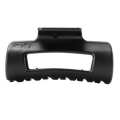
Instead of accepting that claw clips have to be hard and rigid, Mello uses CloudFlex™ engineered material, which is designed to flex and compress while still supporting your hairstyle.
The Mello Clip also uses inward-facing curved prongs designed to distribute pressure more evenly and a flatter handle that makes leaning against chairs and headrests more comfortable.
And because comfort depends partly on fit, Mello Clips come in Mini, Classic, and Jumbo sizes for different amounts of hair.
The goal isn't to reinvent what a claw clip does.
It's still supposed to hold your hair.
The difference is thinking much more carefully about how that clip feels while it's doing its job.
The Best Test Is Your Normal Day
You don't need a special occasion to figure out whether a hair clip is comfortable.
Wear it through your normal routine.
Put your hair up in the morning. Sit at your desk. Drive somewhere. Go to lunch. Run your errands. Leave your hair alone instead of constantly checking it.
Then notice how you feel several hours later.
Did you keep repositioning the clip? Did you feel pressure in one particular spot? Did you take it out every time you sat in the car? Were you counting down until you could finally let your hair down?
Or did you mostly forget about it?
That's the test that matters.
Maybe You Should Be a Little Skeptical
You don't have to believe that a hair clip is comfortable just because the packaging tells you it is.
Pay attention to the design. Pay attention to how it fits your hair. Most importantly, pay attention to how it feels several hours after you put it on.
Because the biggest difference between an ordinary claw clip and a genuinely comfortable one might not be something you immediately see.
It may simply be how rarely you think about your hair clip once it's in.
Try a Mello Clip during your own normal day and see how long it takes before you forget you're wearing it.