

Summary
-
Soft Doesn't Have to Mean Weak: A softer, more flexible hair clip can still provide reliable hold when its material, spring, prongs, and shape work together.
-
Rigidity Isn't the Only Source of Hold: A hair clip doesn't necessarily need a completely rigid body or excessive pressure to keep an updo secure.
-
Flexibility Can Improve Everyday Comfort: A clip with some give can adapt when you move, sit back, or lean against a headrest.
-
The Right Size Still Matters: Even a well-designed clip can struggle if it doesn't have enough—or has too much—capacity for your hair.
-
Comfort and Hold Can Coexist: The goal is an accessory you don't have to choose between wearing comfortably and keeping your hair in place.
Can a Hair Clip Be Soft and Still Hold Your Hair?
Can Soft Hair Clips Actually Hold Your Hair?
Yes. Soft hair clips can still hold your hair securely when flexibility is supported by thoughtful overall design. A hair clip's hold doesn't come from rigidity alone. Its spring, prong shape, size, construction, and the way it sits around your hair all contribute to whether your hairstyle stays in place.
That's an important distinction because "soft" or "flexible" shouldn't automatically be confused with flimsy.
A clip can have some give when pressure is applied while still having enough structure to support your hairstyle. In fact, this combination can offer an alternative for people who like wearing claw clips but don't love the hard, rigid feeling associated with many traditional designs.
Why Are Traditional Hair Clips Usually So Rigid?
Traditional claw clips are often designed around a straightforward idea: create a solid structure, add a spring, and use the teeth to keep the hair gathered.
That approach can certainly work.
But rigidity can become noticeable when you're wearing a clip for several hours. Something that feels completely fine when you first put your hair up may feel very different later when you're working at a desk, driving, sitting against a chair, or relaxing on the couch.
The problem isn't necessarily that traditional clips can't hold hair. Many do that very well.
The question is whether complete rigidity is necessary to achieve that hold.
Newer flexible designs challenge that assumption by allowing the body of the clip to have some movement while other parts of its construction provide the support necessary to keep hair in place.
What Makes Soft Hair Clips Different?
When we talk about soft hair clips, we're not necessarily talking about something as soft as fabric.
Think flexible rather than rigid.
A thoughtfully designed soft hair clip can compress or flex when pressure is applied and then return to its original shape. Instead of feeling like one completely solid object sitting against your head, the clip has some ability to respond to movement and pressure.
That difference may seem small when you're holding the clip in your hand.
It becomes much more noticeable once you're actually wearing it.
You move throughout the day. You turn your head, sit down, lean back, bend over, walk around, and adjust your position constantly. A flexible hair accessory can respond to some of those movements instead of remaining completely rigid.
But Where Does the Hold Come From?
This is the biggest question.
If the body of a hair clip can flex, what's stopping your hairstyle from falling apart?
The answer is that hold is created by more than the hardness of the material.
The spring matters because it determines how the two sides of the clip come together. The prongs matter because their shape and positioning influence how the clip catches and supports the hair. Size matters because the clip needs enough capacity for the amount of hair you're putting inside it.
Your hairstyle matters too.
A properly sized clip positioned around a well-formed twist can perform very differently from a clip that's too small and barely closes around your hair.
This is why judging a hair clip by squeezing it in your hand doesn't tell you everything about how well it will work.
Soft Doesn't Mean You Should Sacrifice Structure
There's an important balance here.
A hair clip can be flexible without being so soft that it can't support anything.
You still want structure.
You still want a functional spring.
You still want prongs that can support your hair.
And you still want the clip to maintain its shape through regular use.
The difference is that these features don't necessarily require the entire clip to feel completely hard and unyielding.
Think of flexibility as another design element rather than the opposite of strength.
Why Flexibility Matters When You Lean Back
This is one of those things you may never consider when buying a claw clip.
Then you get into your car.
You lean your head against the headrest, and suddenly the clip you forgot you were wearing becomes impossible to ignore.
The same thing can happen in an office chair, on an airplane, on the couch, or anywhere else you want to rest your head comfortably.
A rigid clip doesn't change much when pressure is applied. A flexible clip can have more give, which may make these everyday situations more comfortable.
The shape of the clip matters too. A flatter profile at the back of the head can reduce how much the accessory protrudes when you lean against something.
If you wear your hair up frequently, that's worth considering. Hair accessories don't exist only for the few seconds you're standing in front of your bathroom mirror. They have to come with you through the rest of your day.
Soft Hair Clips Still Need to Be the Right Size
Even the most thoughtfully designed flexible clip won't solve every styling problem if you're using the wrong size.
Fine or short hair generally doesn't need the same capacity as long, thick, curly, or high-volume hair.
If a clip is too large, there may not be enough hair inside for it to hold the way you want. You might compensate by twisting your hair tighter and tighter.
If it's too small, you may end up forcing the clip closed or leaving sections outside because everything simply doesn't fit.
Neither situation is ideal.
Choose soft hair clips based not only on how they feel but also on how much hair they're designed to support.
What Should You Look for in Soft Hair Clips?
Flexibility is a good starting point, but it shouldn't be the only thing you evaluate.
Look at the entire construction.
Does the material return to its shape after flexing? Does the spring feel functional and secure? How are the prongs shaped? Is the clip appropriately sized for your hair? Does the handle protrude significantly from the back of your head? Most importantly, does the clip actually keep your preferred hairstyle in place comfortably?
Those details matter more than whether a product can simply be described as "soft."
A good hair accessory should feel thoughtfully designed as a complete object.
Mello's Approach to a Softer Claw Clip
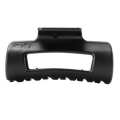
Mello was created around the idea that a claw clip could provide reliable hold without relying on a completely rigid construction.
The Mello Clip uses a flexible material designed to flex, compress, and bounce back without snapping. Its design combines that flexibility with curved prongs, a rust-resistant tension spring, and a handle that lies flat against the back of the head. Mello also reports that the clip has been lab-tested for more than eight hours of hold across hair types from 1A through 4C.
That combination is what makes the concept work.
The flexibility isn't being asked to do everything. It's one part of a larger design that considers hold, pressure, shape, movement, and everyday wear.
It's also why choosing between comfort and hold doesn't have to be an either-or decision.
You Shouldn't Have to Choose Between Soft and Secure
For a long time, it was easy to assume that a good claw clip needed to feel hard, stiff, and strong in your hand.
But the real test isn't how rigid the clip feels before you put it on.
It's what happens afterward.
Does it hold your hairstyle? Can you wear it for hours? Can you move around normally? Can you lean back without immediately wanting to remove it? Do you forget about it once your hair is up?
That's where soft hair clips can offer something different.
Soft doesn't have to mean weak. Flexible doesn't have to mean flimsy. And comfortable doesn't have to mean constantly fixing your hair.
If you're curious about what a flexible approach to the traditional claw clip feels like, explore Mello Clips and find a size designed for your hair, your everyday hairstyles, and the way you actually move through your day.