


Summary
-
Small Clips Suit Smaller Amounts of Hair: They work best for fine, short, or lower-volume hair, and for securing partial sections.
-
They Shine in Half-Up and Partial Styles: Keeping the front or top of your hair back is where a small clip does its best work.
-
Fit Matters More Than Size Alone: A small clip should close comfortably around your hair without being forced.
-
There's a Point Where You Need More Room: If a clip barely closes or you're compressing your hair, it's time to size up.
-
Small Doesn't Mean Weak: Hold depends on construction, spring, prongs, and fit, not just size.
Small Hair Clips: What They're Best For and When to Size Up
What Are Small Hair Clips Best For?
Small hair clips are best for securing a smaller amount of hair: half-up styles, face-framing pieces, short or fine hair, and partial twists. They're designed to close around a limited section without needing extra tightening, which makes them useful when a larger clip would leave too much empty space.
If you've ever tried to hold a small section of hair with a big clip and watched it slide out, you already know why size matters. A clip that matches the amount of hair it's holding usually stays put more comfortably.
Who Should Use Small Hair Clips?
Small clips tend to work well for people with fine, short, or lower-volume hair, since there isn't enough hair to fill a larger clip. They're also useful for anyone who wants to pull back only part of their hair, regardless of length or thickness.
That includes people with long hair who prefer half-up looks, people growing out bangs or layers, and anyone who wants a quick way to keep hair off their face during a workout, while driving, or at a desk.
What Hairstyles Work With Small Hair Clips?
A few styles are especially well suited. A half-up style, where you gather the top section and secure it at the back of your head. A pulled-back front section, which keeps bangs or face-framing pieces out of your eyes. Small twists on shorter hair, where a full-size clip would be too much. And partial French twists or low twists, where you're only gathering part of your hair.
Small clips also work as a secondary clip. You can use one to hold a section out of the way while styling the rest of your hair, then take it out or leave it in as an accent.
How Do You Wear a Small Hair Clip in a Half-Up Style?
Gather the top section of your hair, either from the crown or from ear to ear, and twist it lightly toward the back of your head. Open the clip and slide it over the twisted section, making sure the prongs also catch some of the hair against your head so it has something to anchor against. Release the clip and adjust any pieces you want to leave loose.
If your hair is fine or smooth, adding a little texture first can help it hold. If you feel the clip slipping, try moving it slightly lower or angling the twist rather than tightening.
Can Small Hair Clips Hold Thick or Long Hair?
Sometimes, but usually not for a full style. A small clip can hold a section of thick or long hair, such as a half-up section or a front piece, but it's not designed to hold a full twist or ponytail. Trying to force a large amount of hair into a small clip often means compressing it or twisting it tightly, which adds tension without improving the hold.
For a full updo with thick, long, or voluminous hair, a larger clip with more capacity is usually a better choice.
How Do You Know When to Size Up?
A few signs suggest a small clip isn't the right fit. It barely closes or won't close without force. You're twisting your hair tighter and tighter just to make it fit. The clip slides or sags as the day goes on. You notice tension or tenderness where it sits. Or you're leaving sections of hair out because everything simply doesn't fit.
None of these mean small clips aren't good. They mean the amount of hair has outgrown the clip. Keeping both a small and a larger clip on hand covers different styles.
Does Small Mean Less Secure?
Not necessarily. Hold comes from the overall construction: the spring, the prongs, the shape, and the fit between clip and hair. A well-designed small clip can hold securely when it's holding the right amount of hair. It's when you ask it to hold more than it was designed for that it struggles.
Flexibility can also make a difference for comfort. A clip that compresses slightly under pressure and returns to shape can feel gentler against your head than a rigid one, especially if you wear it for hours.
Mello's Approach to Small Clips
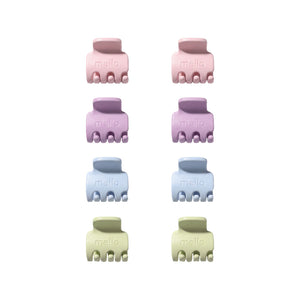
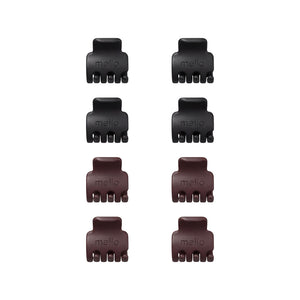
Mello's Mini Clip uses the same flexible CloudFlex™ construction as the rest of the lineup, sized for fine, short, or lower-volume hair and for half-up styles and small sections. The curved, inward-facing prongs are designed to close gently, and the flat handle sits comfortably against your head.
If you wear a mix of styles, pairing a Mini with a Classic or Jumbo gives you a clip for each situation, so you're never forcing hair into the wrong size.
Choose the Size That Fits Your Hair
Small hair clips are a great fit when you're holding a smaller amount of hair, and they're not meant to do everything. Think about how much hair you're securing, how it feels after a few hours, and whether you're compensating with extra tightness.
If you're ready to find a size that fits, Mello Clips are a good place to start, especially if you want a few sizes for different hairstyles.


